Plant biology
Photosynthesis
How leaves capture sunlight and turn it into stored energy.
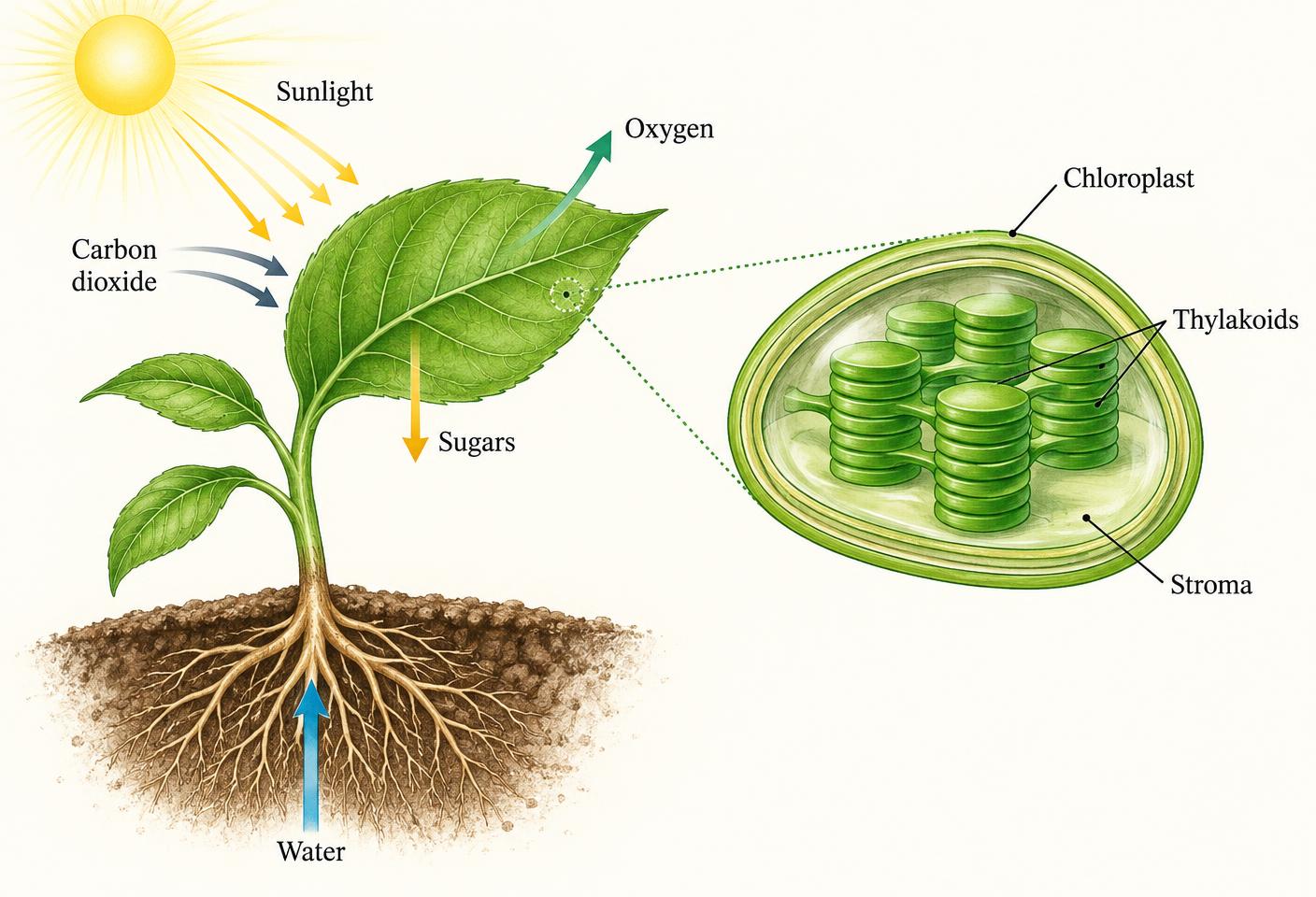
From sunlight to sugar
The arrows around the leaf show the ingredients and products of photosynthesis. Water travels up from the roots, while carbon dioxide enters through tiny pores in the leaf called stomata. Inside the leaf, chloroplasts use light energy to help build sugars from carbon dioxide. These sugars supply material for growth and fuel for cellular respiration.
The enlarged chloroplast reveals stacks of disks called thylakoids. Their membranes contain chlorophyll, the green pigment that absorbs light. Light-driven reactions here split water, releasing oxygen and producing energy-carrying molecules. In the surrounding fluid, the stroma, the Calvin cycle uses those carriers to help turn carbon dioxide into the building blocks of sugars.
The bigger picture
Plants have mitochondria too. Photosynthesis stores energy in organic molecules; cellular respiration releases some of that energy into ATP. Plants respire during both day and night.
Key terms
- Chlorophyll
- A pigment that absorbs light energy.
- Stomata
- Leaf pores that regulate gas exchange and water loss.
- Thylakoids
- Membrane sacs where the light-driven reactions occur.
- Stroma
- The fluid inside a chloroplast surrounding its thylakoids.